Unknown's avatar

About martin.p.eccles

My practice reflects the experience of my presence in and walking through natural environments. I use a range of methods (predominantly sound and text) to respond to time, distance and place in the landscape.

four rants for the summer solstice (after John Cage, 1977)

To celebrate the winter solstice I will be playing a four hour, four-channel, sound piece in The Arches on the campus of Newcastle University. It will play continuously from 09:00 on Saturday 21st December until 09:00 on Monday 23rd December.
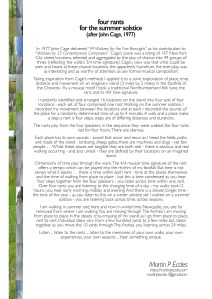
In 1977 John Cage delivered “49 Waltzes for the Five Boroughs” as his contribution to “Waltzes by 25 Contemporary Composers”. Cage’s score was a listing of 147 New York City street locations, selected and aggregated by the play of chance into 49 groups of three (reflecting the waltz’s 3/4 time signature). Cage’s view was that what could be seen and heard at these chance locations, the apparently humdrum, the everyday, was as interesting and as worthy of attention, as any formal musical composition.
Taking inspiration from Cage’s methods I applied it to a sonic exploration of place, time, distance and movement on an imaginary island (3 miles by 2 miles) in the foothills of the Cheviots.  As a musical motif I took a traditional Northumberland folk tune, the rant, and its 4/4 time signature.
I randomly identified and arranged 16 locations on the island into four sets of four locations – each set of four comprised one rant. Walking on the summer solstice, I recorded my movement between the locations and at each I recorded the sounds of the place for a randomly determined time of up to 4 minutes. A walk and a place make a step; a rant is four steps; steps are of differing distances and durations.
The rants play from the four speakers, in the sequence they were walked; the four rants last for four hours. There are silences.
Each place has its own sounds – sound that occur and recur as I tread the fields, paths and roads of the island – birdsong, sheep, gates; there are machines and dogs – yet few people … Whilst these places are tangible they are both real – there is obvious and real walking occurring – and also unreal – they are defined by their locations on an imagined island.
Dimensions of time play through the work. The 4/4 musical time signature of the rant offers a tempo which can be played into the rhythm of my footfall. But time is not always what it seems … there is time within each rant – time at the places themselves and the time of walking from place to place – but this is time condensed as you hear four steps together from the four speakers – you listen across time within one rant.  Over four rants you are listening to the changing time of a day – my walks took12 hours.; you hear early morning, midday and evening. And there is a slower, longer, time – the time of the year – as you listen to this on a winter solstice yet I walked on a summer solstice – you are listening back across time, across seasons.
I am walking in summer and, here and now, in wintertime Newcastle, you are far  removed from where I am walking. You are moving through The Arches; I am moving from place to place in the steady criss-crossing of my island as I go from place to place, rant to rant. Individual steps vary from a few hundred yards to a few miles but, taken together, as you move the 10 yards through The Arches, you listening across 24 miles.
Listen … listen to the rants … listen to the memories of your own walks, your own experiences, your own seasons … hear something unique.

Listening and walking in Ljubljana: Št 2: “brez sledi”

An invitation to exhibit at Steklenik (http://www.steklenik.si/en/home/) resulted in a mid-November trip to Ljubljana. Steklenik, a partnership project of the Cona Institute (run by Brane Zorman and Irena Pivka; http://www.cona.si) and the University Botanic Gardens Ljubljana, is a sound gallery space, a greenhouse with an integrated 8-channel sound system.

I had been invited to install my 8-channel work No.2: “no trace”

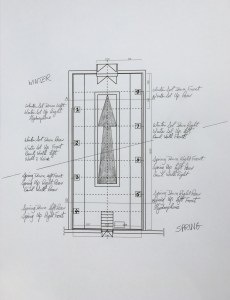
which, in summary, presents two walks, each one upstream and downstream, along a common route, in a river; the two walks were made on the winter solstice and the spring equinox. I had been working towards preparing this for a few weeks in advance of travelling. The set up in the gallery is of four speakers along each side wall fixed to the metal ribs of the building and sitting above a waist high, one metre deep shelf that runs the length of each long side; there is a low island flower bed centrally placed on the floor and slightly closer to one end of the gallery; all surfaces are covered in plants, mainly cacti.

Whilst there were technical reasons (manageable but clunky) and practical reasons (the centre of the room was not accessible) why I wasn’t going to repeat the Cheeseburn Grange installation of an ambisonic diffusion, my overall reason was aesthetic. I wanted to produce more of a focus on the speakers, their individual outputs and the physical and conceptual distances between them.

I ended up with a composition that had a number of features:

  • the direction of flow of the river was from the entrance to the gallery towards the external doors
  • the quadrophonic winter recordings were placed in the four distant speakers
  • the quadrophonic spring recordings were placed in the four near speakers
  • bank walk and narrated river walk recordings were placed centrally
  • hydrophone recordings were placed at either end

Having adjusted the gain – a general increase of about 5dB in response to a larger space than I had been editing the composition in and a setting that meant that whilst you could hear the work as an overall composition, you would hear more detail if you more closely approached individual speakers – the work offered ideas on walking, time and distance. The impact on my walking was described in the original exhibition catalogue essay (https://martinpeccles.com/sound-works/trace-no-trace/). In terms of time and distance then a listener could listen to and move between winter and spring as they walked between the two ends of the gallery, they could listen to the turn of the year, the change of the seasons. They could hear my progress along the river and match this to their own movement around the gallery, listening to my walking a mile as they walked the floor of the gallery. However, importantly, there was no single ‘sweet spot’ within the gallery where the work could be experienced; it was designed to be experienced by moving, by walking, by replicating my actions in creating it. Thus, each listener, with their own movement and listening, co-creates their own unique experience.

The composition opening was at midday on Saturday 16th November and I did a live performance at 19:00 on Tuesday 19th November …

I had a great time in Ljubljana – walking, recording, installing and performing – many thanks to Brane and Irena who were wonderful hosts.

A Walk with Horns: “playing” the St John’s Harbour Symphony

The St John’s Harbour Symphony (http://www.soundsymposium.com/about/harbour-symphony/) (played on 1st July this year (2019)) is a striking sonic event. A composition for ship’s horns it takes place in, and resonates around, the natural amphitheatre of St John’s Harbour, Newfoundland. In a response to the live performance I walked a route in the immediate harbour area.
As well as the pair of microphones that travelled with me on my walk, a third microphone remained on the quayside (for which my grateful thanks to Jeremy Grimshaw). Heard from the quayside, the natural bowl of the harbour produces the obvious echo of the cannon shot that are giving percussive punctuation to the horns’ drones. Although initially synchronous, as I walk away from the quayside the ‘distance between the recordings’ increases, the architecture changes, and the sounds of the symphony become more complex – less apparent in the horns, the cannon shots eventually separate into complex quadruple sounds. A Walk with Horns “plays the symphony” making audible the shifting sounds of walked streets, people, traffic and the echoing buildings of downtown St John’s.

https://martinpeccles.com/sound-works/a-walk-with-horns/ ‎

“Beàrnaraigh” – a 24h art radio show on Radiophrenia

With the recent conclusion of the Beàrnaraigh series on Resonance EXTRA it was a pleasure to have the complete 24h version accepted for broadcast by Radiophrenia 2019 (26th May 2019  11:59 pm – 27th May 2019  11:59 pm).
Radiophrenia is a temporary art radio station – a two-week exploration into current trends in sound and transmission arts. Broadcast live from Glasgow’s Centre for Contemporary Arts, the station aims to promote radio as an art form, encouraging challenging and radical new approaches to the medium. This May was its fourth year (previously in 2015, 2016 and 2017).
The ideas behind Beàrnaraigh are the same as before (in a blog post from October, below) but here the piece was an extended whole, broadcast as the final, internet only, work of the two week programme.
During the broadcast I hosted a three-hour, 8-channel surround sound version – thanks to everyone who came, it was great to see you all. If you missed any of it then it is now available on my SoundCloud account –

Búðahraun

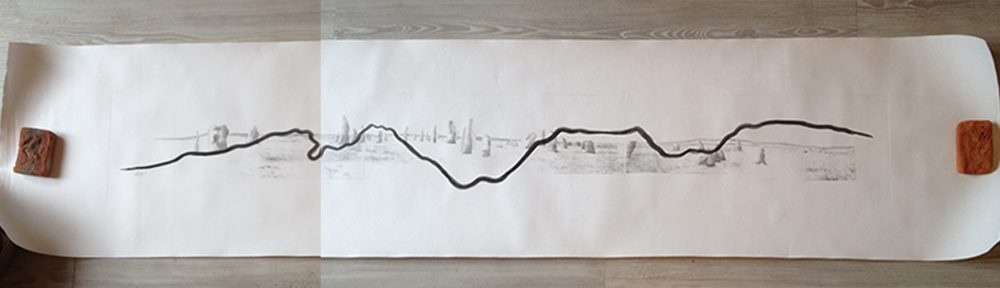
I start at the back of the wooden church. In the evening light, a family wanders the graveyard but at dawn I am alone. Along the narrow path the back-of-the-beach grass transitions into the ridges, fissures and clefts of the Búðahraun lava field. Marram grass yields to rock – lichen crusted, rounded with moss – a surface razed of vegetation of any meaningful height.

from across black lava
I hear fluty chatter,
song of redwings.

I step, stride, walk the path
to the solstice turn
dusk to dawn, dawn to dusk

Búðahraun

A two hour radio work: Flux #2 Búðahraun

A slightly different opportunity to broadcast work with Resonance Extra. ‘Flux’is a monthly radio show (curated by James Davoll) that explores themes of liminal space, temporality and boundaries, whether physical or theoretical. This exploration is carried out through field recording and sound design. The next show, Búðahraun, is brought to you by me (scheduled for broadcast (https://extra.resonance.fm) on Sunday January 6th2019, 16:00 – 18:00). My thanks to James and to everyone at Resonance Extra.
The ideas
The work examines distance, time, movement and place from replicated walks into the remote, coastal, Icelandic lava field of Búðahraun. I walked a ‘there-and-back’ route twice, once at dawn and once at dusk; distance is the distance of the walk, the accumulated distance of the two walks as well as the distance heard across the lava field.
As well as the elapsed time of the walks themselves, temporality is present as the time of day but also the time between the walks – the time of a day – and, as the walks took place around the summer solstice, the time of year. You also hear across time. The structure of the two recordings was the same – walk in, rest, walk out. In order to present listening across time the composition runs as follows: walk one walk-in; walk 2 rest; walk one walk-out; walk two walk-in; walk 1 rest; walk 2 walk-out. Both ‘rests’ overlap the walks at either end, so at any point in time you are listening to recordings that are presented as simultaneous but are 12 hours apart and across the piece as a whole these are two different 12-hour intervals.
Movement comes directly from my footfall, my embodied movement across the rock, but also from the comings and goings of the birds as they, and their calls, songs, and displays move over the lava field. Together these elements contribute to a sonic portrait of a place but they also create a space to allow a listener to hear a place of their own.

Búðahraun

“Beàrnaraigh” – a body of work as a 24 episode art radio show

I have a great opportunity to present a body of work as a 24 episode art radio show – “Beàrnaraigh” – starts Friday 2nd November (09.00-10.00) and runs at the same time every Friday until mid-April (https://extra.resonance.fm/series/bearnaraigh). It is broadcast by Resonance EXTRA (https://extra.resonance.fm).
You can listen live at each Friday morning or listen to an archived version on MixCloud (there’s a link on the Resonance EXTRA web page).

Beàrnaraigh is a body of work recorded in June 2018 on a small island in the Outer Hebrides.
A small island is a tangible, coherent whole. It can be walked around, much of it can be seen from a single strategic vantage point and in an archipelago, as Beàrnaraigh is, it forms one part of a larger whole. Prompted by any circumnavigation of an island being either clockwise or anti-clockwise, horology parallels emerge – the shape of the island and the shape of a clock face, the movement of hands across the face of a clock and the clockwise circumnavigating walker, archipelagos of minutes grouped into hours, themselves grouped into days … and so on … and so on …
… and so … each episode presents one of the series of the 24 hours of the day; 12 present (one or more) walks from a complete, clockwise, circumnavigation of Beàrnaraigh and 12 present the island alone. Each episode is recorded in its allocated hour. Some are in immediate succession from one hour to its next; others are a span of days away from their juxtaposed neighbour.
Beàrnaraigh offers thoughts of time and distance
time is perhaps …
the passing 60 minutes of listening
the transition from one hour to the next, sometimes sequential, as when a hand crosses a clock’s face … but sometimes not
the apparent “24 hours of a day” composed from the 20 days over which the recordings were made
then there is distance …
the distance walked in one hour
the distance within a walk across hours
the distance of a circumnavigation of the island
the distance walked …

Thanks to all at Resonance EXTRA.

My Allenbanks Renga

Having talked about the writing process in a previous post, here is the Renga that I wrote.

The edge of autumn

Today’s truth –
the seventh month is our ninth
white river brown

grassheads dance
to a chainsaw’s tune

branches sway
trunks creak
above dropped leaves

the canopy pours green
onto the path

uphill
tripping on roots
my breathing quickens

on the gorge edge
the updraft lifts the sky

leaf needle twig
strewn stone
steps down to the pond

sedge reed and lily
the tarn lies still

light shades
from bending leaves
pollen blown as rain

a dragonfly
hunts the glade

pheasants creep away
through bracken
a plant of an earlier time

fallen trees
soften into earth

swallows skim
the edge of autumn
rain mists the meadow

around over along
the Allen sings.

A 14-verse Renga at Allen Banks,
Morralee Wood,
on 6th September 2017,
by Martin P Eccles.

My introduction to the poetic art of a walking Renga

The day was organised by poet, and the days ‘Renga Master’, Linda France. Along with Linda and eight others I took part in a walking Renga at Allenbanks, Northumberland. Our two-mile route was chosen by Linda and related to her interest in Susan Davidson who, in the mid 1800’s, designed much of Allenbanks as experienced today.

Though I had written haiku whilst walking, the Renga was new to me. The traditional length of a Renga varies, though is often 20 verses – today we were writing 14 verses. A Renga has a basic structure of alternating three and two line verses, each a response to a place along the way. There is an underlying compositional ‘link and shift’ principle – verses are linked by, in this case, the act of the walk; the shift is that, in general, verses don’t repeat ideas or images previously mentioned. There is usually a central set of three love verses and in our case these became three verses based around one location on the walk – the Tarn in Moralee Wood.

The walks between verses were relatively short and (deliberately) slow, and whilst companionable, were conducted without ‘chat’ – to allow us to absorb, reflect on and respond to the place where we were walking. Each stop was about ten minutes during which we each composed one (occasionally two) verses. At the end of the ten minutes we then each read our verse (preceded by the chosen verse from the previous stop) and the Renga Master then chose one of the offered verses to go into the group Renga. As well as writing the group Renga we were also each writing our own Renga. The whole walk and writing took about five and a half hours.

The day was hugely enjoyable, walking with a group of poets and contributing to a shared end. Equally, I can think of ways in which I can use this method and discipline to inform my own practice as a solitary walker. I am very much looking forward to the next one, whenever that might be.

This is the group Renga that we all wrote.

The Landscape, Ourselves

Today’s truth –
the seventh month is our ninth
white river brown

a startled heron
wingbeat of silence

what is that sumptuous smell?
she only knows it
as ‘country’

a choice is made
to keep to the middle way

uphill
tripping on roots
my breathing quickens

through the ghost of a window
we gaze over the valley

mirror tarnished
by pondweed
waterlily

layer upon layer
memories settle

my companions are painting light
collecting earth
gathering pollen

by the water
a stack of wooden bones

and so we lean
into the landscape
ourselves

picture the moonlight
shadowing these branches

in a wild grove
between two fields
with all that’s unspoken

Allen
muttering, meandering.

A 14-verse Renga at Allen Banks, Morralee Wood, on 6th September 2017.

Participants: Jo Aris, Matilda Bevan, Holly Clay, Martin Eccles, Linda France, Malcolm Green, Sharon Higginson, Alex Reed, Eileen Ridley, Christine Taylor


4 Midsummer Eve Rants, 20/06/2017 Alnham

Notes from walking the four rants

I have made a previous post from this – here is my basic set of notes about my conduct of the Rants.

Up at 04:30, on site just before 06:00 and walking by about 06:20. Initial dismay whilst changing into my boots as I am being bitten by tiny black droplets of insects and I have no repellent. On with a beanie hat to give a physical barrier. Connect my kit, lock the car and set off only to find I have a marked creak from my rucksack. Unable to make it stop I walk back to the car and swap to a smaller, frameless rucksack that I have tried out the weekend before. It is slightly less comfy but silent.

The first leg is the Salter’s Way almost to the start of the open-access land then a hop over the fence to the ditch at the edge of the crop field. The path is heavily overgrown and wet with dew. I am, from the knees down, sodden.
There is a view over the upper Aln valley down to the Simonsides and across towards the coast. A gentle breeze and overcast sky (although this will clear). Pretty quiet with occasional birdsong and sheep.

uphill, crop field, hawthorn, dew-wet grass, drystone wall

Rant 1 Step 1
Very still. The wind barely moving the grass heads as they poke up amongst the oats. Distant chaffinch, wood pigeon – coo coo cooo coo coo – trala lah trallooah. The conversation of the sheep – naaah naaah. Occasional passing of a fly. Two hawthorn hedges, several plantations, down to the valley, rolling fields. Distant wood, bottom edges of the trees shaved off, grazed away, a low-level ceiling before the roof of the trees takes over. Drystone wall, capstones cemented in place, dark grey of the stone obliterated by the pale green-grey of the lichen, occasionally yellow.

Rant 1 Step 1 to Step 2 – along the edge of farm and fell then up to the edge of a conifer plantation. The way passes along a line of very old mature trees – Oak, Hornbeam – presumably marking an old way on the Prendwick estate. The plantation is part of the Prendwick estate shooting activities, heavily fenced – head high plus electric fencing. Dark interiors, surprisingly few gamebirds in evidence. Here the view is lower with other plantations – Four Doors, Churchbrae, Southbraes. The main birds calling and flying are wood pigeons.

Rant 1 Step 2

conifers, fenced plantation, game bird pens, valley burn
Long view across to low cloud on the hills. Cooing of the wood pigeon. Low thrum of the wind through pines. Distant wakening of the farm. Quiet call of the crows.

Rant 1 Step 2 to Step 3, the single longest step down to the south of “the island”. Back down the slope and over the Prendwick Burn, before the rough pasture, slow climb to the Salter’s Road. Down the hill to the site of the mediaeval village and east to the road junction. Crossing directly over the road and then wading the nascent Aln. The field is running with ewes and their lambs, lots of bleating as they stop/start run back and forth. The track goes up a slow gentle hill through two gates and a stockyard. Further up the hill three hares run from the path into the field and disappear over a low rise. Carrying on there is a gate in the wall and then a sharp left turn to start tracing the edge of the large crop field. Skylarks are flying in and out of the crop; one is moving ahead of me sequentially perching on fence posts before it finally leaves. At least two are singing; small dark jewels suspended in the sky by the thread of their song. At the junction with the track the way is to the right and along for about 400 m before moving to the site in the field to the south.

Rant 1 Step 3 
water trough, skylarks, crops, tyre lanes, distant road

Rant 1 Step 3 to Step 4 – I walk down the hill, through the gate at the bottom of the Hawthorne hedge and on through the buildings Scrainwood Farm. Walking into the field I follow the tire tracks which are symmetrically etched across the field until I reach the next recording site. Here land is lower; I have crossed the watershed between the Aln and the Coquet, the fields are full of crops, the woods are full of thrushes singing.

Rant 1 Step 4 

thrush song, solid wheat, farm, road, fence

Quiet rustle of the heads of the wheat as they rock in unison in the wind. The monotonous cooing of the collared doves. Distant blackbird demonstrating flutey song. Background hum of insects, a low drone.

Rant 1 Step 4 to Rant 2 Step 1. With rant one complete the way now goes north along the road. The next site is in the middle of a crop field and inaccessible. Whilst I record at the nearest point I will not use the recording.

roadside, crop, house, swallows

Rant 2 Step 1

Rant 2 Step 1 to Step 2. Rant two continues back at the Salters Road, so the way is along the road and then taking a shortcut which goes directly through the site of the remains of Alnham Castle. Stepping across the river Aln and over the wall I walk back up the Salter’s way to the edge of the moorland, turn to the north-east and the next site is amongst the trees of the ancient Avenue.

Rant 2 Step 2
shelter, old trees, fence, edge

Rant 2 Step 2 to Step 3 – Turning back on myself I retrace my steps towards the top the Salter’s Road. This time I continue on and go over the top of the hill descending towards the valley of a stream that will eventually flow into the Scrainwood burn. My destination is 300 m into the field that contains a herd of cows with their calves, still small, and a single Charolaise bull. He shows no interest in me and the heifers have moved their calves away and stand at a safe distance watching me. I’m standing in the middle the blog and have made sure that move slowly, I know where my nearest escape routes are should either the heifers or the bull become overly interested.

Rant 2 Step 3

bog, slow, hill, larks
Freshening wind cooling against the exertions of the walk. Terratorial skylarks suspended by the thread of their song. Anxious heifers shepherding their calves around the field keeping them away from me. I make sure to move slowly so that I don’t startle them. They begin to feed again after I leave. The large bull stays on the ridge, utterly disinterested. More intent on keeping up with the small group of heifers than he is engaging with me.

Rant 2 Step 3 to Step 4. I climb out of the field and retrace my steps to the top of the Salters Road and then down the hill once more. The final site for Rant Two is back at the bottom of the island. In fact it is on the southern limit. The way takes me back over the site of the castle, onto the road, across the watershed once more and down to Scrainwood farm going southeast at Scrainwood and down a track following the path of the Scrainwood Burn I reach a point close to the site which is inaccessible in a field of flax.
(I record as close as I can. The recorder battery goes flat and I have to return to the car and come back with a fresh supply of batteries – 2 ½ miles I didn’t need to walk.)

Rant 2 Step 4

flax, gate, dense grown, river valley

Rant 2 Step 4 to Rant 3 Step 1. This start for Rant 3 is very close – through the gate up to a gap in the hawthorn hedge where I follow a vague track through the shrubbery and stand on the soil of the field.

Rant 3 Step 1
hawthorn hedge, scrainwood farm, crop cover, partridge

The umbels of cow parsley starting to rise and spread above the nettles; sweet cicely going over. Distant crows. The fluctuating, undulating hum of insect pollinators as they go about their work.

Rant 3 Step 1 to Rant 3 Step 2 – up by Castle Hill and so the walk goes back through the farm, then follows the burn up to Hazleton Rig, through Hazleton rig Plantation across to Castle Hill and on into a hay meadow to the north east. The plantation is cool and quiet; sound is dampened by the close pine trees and the moist earth. I have to pick my way through an obstructed track for the second half the plantation walk.

Rant 3 Step 2
grass meadow, clover, sheep, mowing hay

Rant 3 Step 3 is back over the Prendwick Burn. I can cross country walk through the gap between Pennylaw’s South and Pennylaw’s North plantations to the top of the Salters Road. I retrace my steps along the ancient line of trees, cross the Prendwick burn and walked diagonally over the field to the edge of the plantation.

Rant 3 Step 3
plantation, pheasant, wood pigeon, close trees

Rant 3 Step 4 is back by the site of the ancient mediaeval village so I am once again retracing my steps to the top of the Salters Road down the hill. Turning right over the cattle grid to the roadside site. Another herd of cattle is loose in the field and again they move slowly away from me.

Rant 3 Step 4
downhill, road, cows, stream

Rant 4 – the way is straight up the hill, ignoring the road, heading for Castle Hill. Through the gate and across the field I reach the site.

Rant 4 Step 1
uphill, hairpin bends, ringing gate

Rant 4 Step 2 is in the middle of a field close to Prendwick Farm. I have not been able to get a view of this field and so don’t know if it will be a crop field and inaccessible to me. I take the slightly easier route along the road and get to the bottom of the field at the east end of Southbraes Plantation. It is a pasture field with flocks of shorn sheep and about 30 cows. I walk up the field to the site at the north end of it.

Rant 4 Step 2
grass, shearing, sheep, cows, avenue

Rant 4 Step 2 to Step 3 – The remaining two sites are very close together and back towards Castle Hill. From where I am the quickest route is north to a track that runs through the Prendwick Estate at the right angle bend I carry straight on and walk the southern margin of a wheat field to get back onto the Salter’s Road. From here I walk up to the top of Pennylaws South Plantation and then climb the wall to walk the rough pasture to the site to the west of Pennylaws North Plantation.

Rant 4 Step 3
rough pasture, trees

To reach the final site I skirt the top of Pennylaws North Plantation and walk towards the wall that is the west boundary of the Salter’s Road. The site is at the same level as the very first site but on rough pasture the site is easy to find.

Rant 4 Step 4
wall, hawthorn, boulder

I climbed the wall, step onto the Salters Road and for the last time walk down the hill.