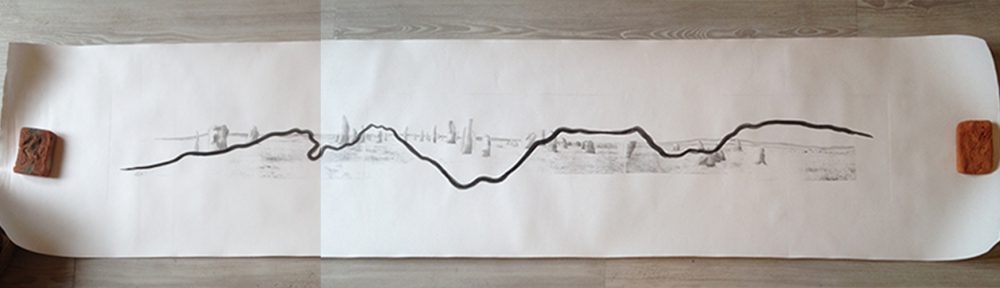
Another provocation from Kel Portman resulted in (t)his curation of eight works from 11 artists. My solstice walk around Dove Crag Island started at dawn as I walked the margins of the island.
Tag Archives: place
Ronaigh – on Radiophrenia this coming Sunday
Radiophrenia – https://radiophrenia.scot/listen/ – 13 April 2025 10:00 am – 11:30 am
July.
40 miles off the top of the Outer Hebrides.
Stand below St Ronan’s church. Walk south on lazy bed corrugations to the low cliffs.
Turn east. Pass two geos. Walk up towards the lighthouse and the east coast peak, to stand above a land-slipped cliff edge.
Walk west onto, along, over the ridge and down the long slope to the west side of the northern peninsula.
Walk onto the rock field. Walk to the end of the peninsula. Walk round the tip and south along the eastern coast to the landing.
Radiophrenia and three of my works
Radiophrenia is back – Monday April 7th to Sunday April 20th.
I have three works appearing and the first is Hallaig on 7 April 2025 4:30 am – 6:30 am
May.
The Hebridean island of Raasay.
From a beach below Gualann na Leac walk up the slope to the path, the cairn and the milepost. Follow the track north into the birchwood and walk down through the woods towards the waterfall; stop on a small bluff. Retrace my way, cross the Hallaig Burn, walk up the hill to the lost (by edict of a nineteenth century landlord) village of Hallaig.
Walk the stones of the houses.
Walk back, south, cross the burn at the ford. Walk on, beyond the milepost, then turn, and walk down the slope to the beach.
Remember, no archive, no replays, live only – Radiophrenia – https://radiophrenia.scot/
Terminalia 2025
It was great to be able to put my Terminalia work into Kel Portman’s call and be part of this wonderful group of walking artists – here is the final version of the works – enjoy.
A walk on Dove Crag Island for Terminalia 2025
Dove Crag Island is created by my human-scale movement and my imagination. I walk the island once each month across the turning of the year. For Terminalia I walk an eight-mile shoreline … a boundary of an imagined island … in north Northumberland.
In light snow I walk
the shore of Dove Crag Island.
The land is sodden.
Amongst The Oaks
one blackbird flies, then three more.
Cold grips the woodland.
Boot-knock on wet boards.
I stand on the wooden bridge
above the tumbling burn.
The shoreline turns east.
Amongst trees my chill eases
as the wind drops away.
I watch a field empty.
Sheep run to the sound of
the shepherd’s quad bike.
Rievaulx: a sense of place
During a recent visit, I was forcibly reminded that Rievaulx and its surroundings have, for me, a strong sense of place; it generates in my thoughts words like ‘peaceful’, ‘tranquil’, ‘restful’ and I’d like to try and work out something of why this might be. My recent visit was on a clear, crisp December morning. The sun shone all day and whilst it was never anything other than cold the day was invigorating. It being a week before Christmas meant that few people were around and the valley was quiet. So, the conditions were conducive to my thoughts of peacefulness but I have been there before, in bad weather, when more people were around and the sense has still been there, so while context may have contributed to my sense of peacefulness on my recent visit, it doesn’t feel like the whole story.
Rievaulx is a hamlet of about 20 dwellings in Ryedale, a steep sided river valley on the south-west edge of the North York Moors. It’s most striking feature is a ruined Cistercian monastery dating from the 12th century and closed in 1538 during Henry VIII’s suppression of the monasteries. It would be possible to assume that a sense of tranquility was linked to its religious history or some sort of enduring spiritual presence. Yet, the monastery hasn’t functioned for 400 years and during its 400 years of functioning, life would not have been easy, tranquil, or necessarily peaceful; Cistercians were noted for their austerity; on one occasion the monastery was sacked by Scots and on another the monks were badly afflicted by the plague. After its closure it was the site of an iron foundry for a further 100 years until local supplies of timber for charcoal were exhausted. So, whilst Abbot Aelfred wrote of Rievaulx’s peacefulness and tranquility, a ruin doesn’t automatically translate into a sense of peace. Rievaulx’s abbey ruins became a destination of romantic travel in the 18th century and the then landowner created a valley top walk to the north of the abbey with specifically cleared lines of sight down to the ruins to facilitate its viewing. So, the valley has been through periods of being a religious center, an industrial complex and a romantic ruin, but the current sense of place is about more than the abbey – the nearby ruined Cistercian abbey at Byland shares many of Rievaulx’s historic and architectural attributes but not its sense of place – what are Rievaulx’s other enduring dimensions of place?
When viewed from a number of standpoints, the valley with its constituent buildings have a sense of harmony – of materials, colour and scale. With many of the extant buildings of the hamlet being part of the original abbey precinct there is harmony of materials with all the buildings built of various types of local sandstone (2012). There is harmony of colour with the worn sandstone of the buildings sitting alongside the natural greens and browns of the valley bottom fields and hedgerows and the grey browns of the heavily wooded valley sides. Finally, there is harmony of scale. With the tallest building, the ruined abbey, tight up against the 70 meter high, near vertical, northern side of the valley and the smaller buildings at valley tree top level, nothing protrudes above the natural skyline – it feels as if the buildings are held within the landscape rather than dominating it.
Whilst Rievaulx is not isolated, with the busy market town of Helmsley only three miles away, the two roads in and out of the valley are narrow and steep and there is little invitation to casual through traffic. Local traffic is relatively sparse and the overall effect of this is relatively low levels of traffic and other mechanical sound. The absence of roads means that to explore the valley to any extent you need to walk. Couple this human pace of movement with the low levels of mechanical noise and the shape of the valley and there is a sonic clarity within the valley. The shape of the valley – steep sided and relatively narrow – lends something of an amphitheater effect to listening in the valley; Jackdaws flying over calling are easily heard. Finally, the river, providing the sound of running water, whilst not widely audible, adds the slightly mesmeric sound of running water into the general soundscape.
Bur Rievaulx does not exist as an abstract idea and its ‘sense’ is a consequence of my interaction with the place. All I have written so far is thinking about my current interactions with Rievaulx but a final dimension of Rievaulx is my personal history of association with the place. I was introduced to Rievaulx as a child by my parents and it was a happy childhood destination that I then revisited as a young man. It has a similar place in my wife’s family history and together we have visited it repeatedly. So, what I have written has emerged from a lineage of experience of over 50 years. No wonder articulating this is complex.
Rievaulx Abbey. Available at: http://www.english-heritage.org.uk/visit/places/rievaulx-abbey/.
(2012) Strategic Stone Study: A Building Stone Atlas of North Yorkshire East and York: English Heritage.
 martin.p.eccles: walk time place sound