A sound installation coming up – ‘One Day in June’

I have a three-day installation coming up – titled ‘One Day in June’, it is a 60 minute, two-channel sound work that is based on work in Iceland.

WHEN: Wednesday February 12th from 10:00 – 13:00; Thursday February 13th from 10:00 – 16:00; Friday February 14th from 10:00 – 13:00

WHERE: It is running in the XL Gallery in the Fine Art Department at Newcastle University (directions below).

========================================

One Day in June: 24 hours in eight movements

eight sequential sections from the

eight successive recordings of a replicated walk

walked every three hours

across a June Icelandic fell

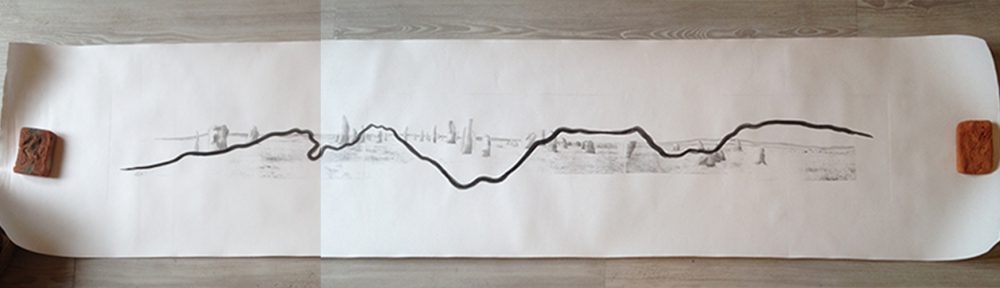
This work presents time, distance and place presented here as: sequential sections from the eight recordings of a replicated walk across an Icelandic fell-side; spoken and written haibun; and a line poem.

The sound recordings step a listener forward, through time and across distance, across a landscape, as I walk the eight times back and forth across an Icelandic fellside. Through the speakers you listen into one walk after another – to a time – one day in June – to a place – a remote Iceland fellside – to the passing of time – the (60 minutes) of the recordings, the hours between walks, my walking for 8 hours, my walking across 24 hours … and to distances – the two miles of a single walk, my overall walking for 16 miles, and the distance from here to the fellside.

The line poem offers letters, words shorn of almost all literary structure or space – words and phrases emerge … and dissolve, thoughts shift as you make and unmake meaning – but it is also be walked along, stepped around … it is not possible to engage with it without moving. As you move along the poems – you move feet in the gallery and miles in Iceland – bring your experiences, your memories                     of movement                  of time    of things that you hear.

All of this is what you are listening to … what you hear is created by you …

==========================================

To get to the XL Gallery – Coming from the Haymarket, pass Kings Gate and go up the steps; pass the Union Building/Northern Stage; go through the Arches into the Quadrangle; the Fine Art Department is up the stone steps immediately on your right. Go up the steps, through the grey double doors and you are in the foyer area – turn right and you will be facing the art shop – and the XL Gallery is on the left beyond the shop.
radioCona: Storyscapes SE – an FM sound art exhibition, live from Ljubljana, Slovenia

The latest manifestation of my sound work “No. 2: ‘no trace’” is playing (as a stereo mix) on radioCona: Storyscapes SE – an FM sound art exhibition, live from Ljubljana, Slovenia, running from 18th to 23rd Jan 2020 from 6.33PM. “No. 2: ‘no trace’” is scheduled to be broadcast at 19:45 tomorrow, Tuesday Jan 21st.

If you’re in Slovenia you can access 88.8 FM. For those of you who aren’t, there is a live stream which can be accessed through this web page:

http://www.radiocona.si/blog/2019/12/18/radiocona-krajine-pripovedi-jv/

or http://tmp.si:8000/radiocona.ogg

You have to access the links using as your browser CHROME, FIREFOX or OPERA – It works fine on a computer/laptop but mobile device access seems more difficult.

So, this is possibly for the more tech savvy and determined amongst you, but hey, no-one ever said art was easy … apart from Giuseppe Chiari … and then David Attwood … but, I think you get my point!

If you make it there are lots of other great soundworks.

Enjoy

four rants for the summer solstice (after John Cage, 1977)

To celebrate the winter solstice I will be playing a four hour, four-channel, sound piece in The Arches on the campus of Newcastle University. It will play continuously from 09:00 on Saturday 21st December until 09:00 on Monday 23rd December.
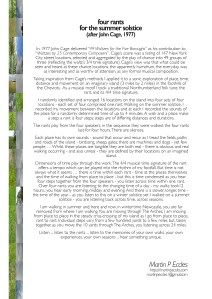
In 1977 John Cage delivered “49 Waltzes for the Five Boroughs” as his contribution to “Waltzes by 25 Contemporary Composers”. Cage’s score was a listing of 147 New York City street locations, selected and aggregated by the play of chance into 49 groups of three (reflecting the waltz’s 3/4 time signature). Cage’s view was that what could be seen and heard at these chance locations, the apparently humdrum, the everyday, was as interesting and as worthy of attention, as any formal musical composition.
Taking inspiration from Cage’s methods I applied it to a sonic exploration of place, time, distance and movement on an imaginary island (3 miles by 2 miles) in the foothills of the Cheviots.  As a musical motif I took a traditional Northumberland folk tune, the rant, and its 4/4 time signature.
I randomly identified and arranged 16 locations on the island into four sets of four locations – each set of four comprised one rant. Walking on the summer solstice, I recorded my movement between the locations and at each I recorded the sounds of the place for a randomly determined time of up to 4 minutes. A walk and a place make a step; a rant is four steps; steps are of differing distances and durations.
The rants play from the four speakers, in the sequence they were walked; the four rants last for four hours. There are silences.
Each place has its own sounds – sound that occur and recur as I tread the fields, paths and roads of the island – birdsong, sheep, gates; there are machines and dogs – yet few people … Whilst these places are tangible they are both real – there is obvious and real walking occurring – and also unreal – they are defined by their locations on an imagined island.
Dimensions of time play through the work. The 4/4 musical time signature of the rant offers a tempo which can be played into the rhythm of my footfall. But time is not always what it seems … there is time within each rant – time at the places themselves and the time of walking from place to place – but this is time condensed as you hear four steps together from the four speakers – you listen across time within one rant.  Over four rants you are listening to the changing time of a day – my walks took12 hours.; you hear early morning, midday and evening. And there is a slower, longer, time – the time of the year – as you listen to this on a winter solstice yet I walked on a summer solstice – you are listening back across time, across seasons.
I am walking in summer and, here and now, in wintertime Newcastle, you are far  removed from where I am walking. You are moving through The Arches; I am moving from place to place in the steady criss-crossing of my island as I go from place to place, rant to rant. Individual steps vary from a few hundred yards to a few miles but, taken together, as you move the 10 yards through The Arches, you listening across 24 miles.
Listen … listen to the rants … listen to the memories of your own walks, your own experiences, your own seasons … hear something unique.

A Walk with Horns: “playing” the St John’s Harbour Symphony

The St John’s Harbour Symphony (http://www.soundsymposium.com/about/harbour-symphony/) (played on 1st July this year (2019)) is a striking sonic event. A composition for ship’s horns it takes place in, and resonates around, the natural amphitheatre of St John’s Harbour, Newfoundland. In a response to the live performance I walked a route in the immediate harbour area.
As well as the pair of microphones that travelled with me on my walk, a third microphone remained on the quayside (for which my grateful thanks to Jeremy Grimshaw). Heard from the quayside, the natural bowl of the harbour produces the obvious echo of the cannon shot that are giving percussive punctuation to the horns’ drones. Although initially synchronous, as I walk away from the quayside the ‘distance between the recordings’ increases, the architecture changes, and the sounds of the symphony become more complex – less apparent in the horns, the cannon shots eventually separate into complex quadruple sounds. A Walk with Horns “plays the symphony” making audible the shifting sounds of walked streets, people, traffic and the echoing buildings of downtown St John’s.

https://martinpeccles.com/sound-works/a-walk-with-horns/

“Beàrnaraigh” – a 24h art radio show on Radiophrenia

With the recent conclusion of the Beàrnaraigh series on Resonance EXTRA it was a pleasure to have the complete 24h version accepted for broadcast by Radiophrenia 2019 (26th May 2019  11:59 pm27th May 2019  11:59 pm).
Radiophrenia is a temporary art radio station – a two-week exploration into current trends in sound and transmission arts. Broadcast live from Glasgow’s Centre for Contemporary Arts, the station aims to promote radio as an art form, encouraging challenging and radical new approaches to the medium. This May was its fourth year (previously in 2015, 2016 and 2017).
The ideas behind Beàrnaraigh are the same as before (in a blog post from October, below) but here the piece was an extended whole, broadcast as the final, internet only, work of the two week programme.
During the broadcast I hosted a three-hour, 8-channel surround sound version – thanks to everyone who came, it was great to see you all. If you missed any of it then it is now available on my SoundCloud account –

Búðahraun

I start at the back of the wooden church. In the evening light, a family wanders the graveyard but at dawn I am alone. Along the narrow path the back-of-the-beach grass transitions into the ridges, fissures and clefts of the Búðahraun lava field. Marram grass yields to rock – lichen crusted, rounded with moss – a surface razed of vegetation of any meaningful height.

from across black lava
I hear fluty chatter,
song of redwings.

I step, stride, walk the path
to the solstice turn
dusk to dawn, dawn to dusk

Búðahraun

A two hour radio work: Flux #2 Búðahraun

A slightly different opportunity to broadcast work with Resonance Extra. ‘Flux’is a monthly radio show (curated by James Davoll) that explores themes of liminal space, temporality and boundaries, whether physical or theoretical. This exploration is carried out through field recording and sound design. The next show, Búðahraun, is brought to you by me (scheduled for broadcast (https://extra.resonance.fm) on Sunday January 6th2019, 16:00 – 18:00). My thanks to James and to everyone at Resonance Extra.
The ideas
The work examines distance, time, movement and place from replicated walks into the remote, coastal, Icelandic lava field of Búðahraun. I walked a ‘there-and-back’ route twice, once at dawn and once at dusk; distance is the distance of the walk, the accumulated distance of the two walks as well as the distance heard across the lava field.
As well as the elapsed time of the walks themselves, temporality is present as the time of day but also the time between the walks – the time of a day – and, as the walks took place around the summer solstice, the time of year. You also hear across time. The structure of the two recordings was the same – walk in, rest, walk out. In order to present listening across time the composition runs as follows: walk one walk-in; walk 2 rest; walk one walk-out; walk two walk-in; walk 1 rest; walk 2 walk-out. Both ‘rests’ overlap the walks at either end, so at any point in time you are listening to recordings that are presented as simultaneous but are 12 hours apart and across the piece as a whole these are two different 12-hour intervals.
Movement comes directly from my footfall, my embodied movement across the rock, but also from the comings and goings of the birds as they, and their calls, songs, and displays move over the lava field. Together these elements contribute to a sonic portrait of a place but they also create a space to allow a listener to hear a place of their own.

Búðahraun

“Beàrnaraigh” – a body of work as a 24 episode art radio show

I have a great opportunity to present a body of work as a 24 episode art radio show – “Beàrnaraigh” – starts Friday 2nd November (09.00-10.00) and runs at the same time every Friday until mid-April (https://extra.resonance.fm/series/bearnaraigh). It is broadcast by Resonance EXTRA (https://extra.resonance.fm).
You can listen live at each Friday morning or listen to an archived version on MixCloud (there’s a link on the Resonance EXTRA web page).

Beàrnaraigh is a body of work recorded in June 2018 on a small island in the Outer Hebrides.
A small island is a tangible, coherent whole. It can be walked around, much of it can be seen from a single strategic vantage point and in an archipelago, as Beàrnaraigh is, it forms one part of a larger whole. Prompted by any circumnavigation of an island being either clockwise or anti-clockwise, horology parallels emerge – the shape of the island and the shape of a clock face, the movement of hands across the face of a clock and the clockwise circumnavigating walker, archipelagos of minutes grouped into hours, themselves grouped into days … and so on … and so on …
… and so … each episode presents one of the series of the 24 hours of the day; 12 present (one or more) walks from a complete, clockwise, circumnavigation of Beàrnaraigh and 12 present the island alone. Each episode is recorded in its allocated hour. Some are in immediate succession from one hour to its next; others are a span of days away from their juxtaposed neighbour.
Beàrnaraigh offers thoughts of time and distance
time is perhaps …
the passing 60 minutes of listening
the transition from one hour to the next, sometimes sequential, as when a hand crosses a clock’s face … but sometimes not
the apparent “24 hours of a day” composed from the 20 days over which the recordings were made
then there is distance …
the distance walked in one hour
the distance within a walk across hours
the distance of a circumnavigation of the island
the distance walked …

Thanks to all at Resonance EXTRA.

My Allenbanks Renga

Having talked about the writing process in a previous post, here is the Renga that I wrote.

The edge of autumn

Today’s truth –
the seventh month is our ninth
white river brown

grassheads dance
to a chainsaw’s tune

branches sway
trunks creak
above dropped leaves

the canopy pours green
onto the path

uphill
tripping on roots
my breathing quickens

on the gorge edge
the updraft lifts the sky

leaf needle twig
strewn stone
steps down to the pond

sedge reed and lily
the tarn lies still

light shades
from bending leaves
pollen blown as rain

a dragonfly
hunts the glade

pheasants creep away
through bracken
a plant of an earlier time

fallen trees
soften into earth

swallows skim
the edge of autumn
rain mists the meadow

around over along
the Allen sings.

A 14-verse Renga at Allen Banks,
Morralee Wood,
on 6th September 2017,
by Martin P Eccles.

My introduction to the poetic art of a walking Renga

The day was organised by poet, and the days ‘Renga Master’, Linda France. Along with Linda and eight others I took part in a walking Renga at Allenbanks, Northumberland. Our two-mile route was chosen by Linda and related to her interest in Susan Davidson who, in the mid 1800’s, designed much of Allenbanks as experienced today.

Though I had written haiku whilst walking, the Renga was new to me. The traditional length of a Renga varies, though is often 20 verses – today we were writing 14 verses. A Renga has a basic structure of alternating three and two line verses, each a response to a place along the way. There is an underlying compositional ‘link and shift’ principle – verses are linked by, in this case, the act of the walk; the shift is that, in general, verses don’t repeat ideas or images previously mentioned. There is usually a central set of three love verses and in our case these became three verses based around one location on the walk – the Tarn in Moralee Wood.

The walks between verses were relatively short and (deliberately) slow, and whilst companionable, were conducted without ‘chat’ – to allow us to absorb, reflect on and respond to the place where we were walking. Each stop was about ten minutes during which we each composed one (occasionally two) verses. At the end of the ten minutes we then each read our verse (preceded by the chosen verse from the previous stop) and the Renga Master then chose one of the offered verses to go into the group Renga. As well as writing the group Renga we were also each writing our own Renga. The whole walk and writing took about five and a half hours.

The day was hugely enjoyable, walking with a group of poets and contributing to a shared end. Equally, I can think of ways in which I can use this method and discipline to inform my own practice as a solitary walker. I am very much looking forward to the next one, whenever that might be.

This is the group Renga that we all wrote.

The Landscape, Ourselves

Today’s truth –
the seventh month is our ninth
white river brown

a startled heron
wingbeat of silence

what is that sumptuous smell?
she only knows it
as ‘country’

a choice is made
to keep to the middle way

uphill
tripping on roots
my breathing quickens

through the ghost of a window
we gaze over the valley

mirror tarnished
by pondweed
waterlily

layer upon layer
memories settle

my companions are painting light
collecting earth
gathering pollen

by the water
a stack of wooden bones

and so we lean
into the landscape
ourselves

picture the moonlight
shadowing these branches

in a wild grove
between two fields
with all that’s unspoken

Allen
muttering, meandering.

A 14-verse Renga at Allen Banks, Morralee Wood, on 6th September 2017.

Participants: Jo Aris, Matilda Bevan, Holly Clay, Martin Eccles, Linda France, Malcolm Green, Sharon Higginson, Alex Reed, Eileen Ridley, Christine Taylor